
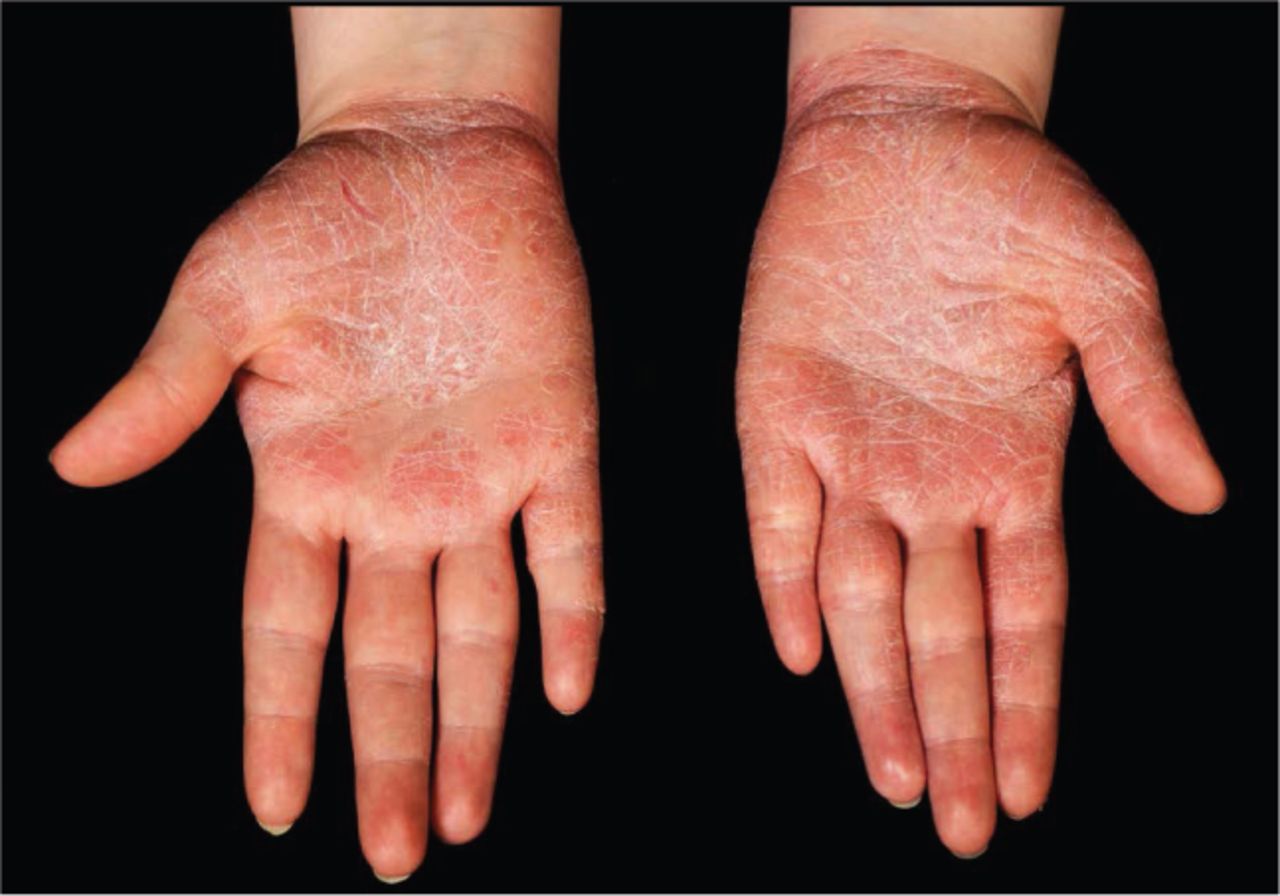
Patients with psoriasis and self-reported psoriatic arthritis (PsA) experienced meaningful improvements in nails, scalp, palms, and soles after initiating treatment with guselkumab, according to study results published in Dermatology and Therapy.
Although guselkumab is approved for adults with moderate to severe psoriasis and active PsA, nail and regional psoriasis assessments have not been performed. Psoriasis in specific difficult-to-treat regions, including psoriasis of the nails, scalp, palms, and soles, is associated with higher disease activity, poorer health-related quality of life (HRQOL), greater disability, and work impairment. Therefore, investigators sought to assess the efficacy of guselkumab on regional psoriasis among adults with a self-reported PsA.
In a post hoc analysis of the phase 3 VOYAGE-1 (ClinicalTrials.gov Identifier: NCT02207231) and VOYAGE-2 (ClinicalTrials.gov Identifier: NCT02207244) trials, the investigators evaluated treatment outcomes in a subset of adult patients with self-reported PsA and moderate to severe psoriasis at week 0 (baseline) who were randomly assigned to treatment with guselkumab 100 mg at week 0, week 4, and then every 8 weeks through week 44; to placebo at weeks 0, 4, and 12, then guselkumab 100 mg at week 16, week 20, and then every 8 weeks; or to adalimumab 80 mg at week 0 then adalimumab 40 mg at week 1 and every 2 weeks thereafter through week 47 in VOYAGE-1 and week 23 in VOYAGE-2. Patients with nonplaque forms of psoriasis were excluded, as were patients who had been receiving treatment with tumor necrosis factor inhibitors within 3 months of study initiation.
The current analyses included a total of 153 patients in the guselkumab group, 106 in the adalimumab group, and 76 in the placebo group. Patients in all 3 treatment groups had comparable characteristics at baseline. At week 16, a greater percentage of patients treated with guselkumab vs placebo showed meaningful clinical improvements as assessed by fingernail Physician’s Global Assessment (f-PGA 0/1; 47.6% vs 17.0%), scalp-specific Investigator’s Global Assessment (ss-IGA 0/1; 80.6% vs 22.7%), hands and/or feet PGA (hf-PGA 0/1; 68.9% vs 14.8%), and Dermatology Life Quality Index (DLQI 0/1; 45.6% vs 2.7%, respectively) (all P <.001). The mean percentage of patients with Nail Psoriasis Area and Severity Index (NAPSI) improvement was also greater with guselkumab at week 16, compared with placebo (39.5% vs 6.5%; P <.001).
At week 24, a greater percentage of patients treated with guselkumab vs adalimumab reached higher ss-IGA 0/1 (77.5% vs 58.5%; P =.003) and DLQI 0/1 (47.7% vs 34.3%; P =.024).
At week 48 in VOYAGE-1, numerically higher response rates were shown with guselkumab vs adalimumab in terms of reaching clear or minimal nail disease and improvements in nail psoriasis; achieving reductions in severity of psoriasis involving the nail matrix and nail bed; and markedly improved psoriasis of the scalp, palms, and/or soles.
Overall, 35 patients in the pooled PsA cohort discontinued guselkumab through week 28, and 16 patients in VOYAGE-1 discontinued guselkumab through week 48.
Study limitations include the small sample size from the VOYAGE studies, misclassification bias in self-reported PsA, and a short treatment duration that did not allow researchers to appropriately discriminate between different therapies for nail disease.
The investigators concluded, “Improvement in psoriasis of these difficult-to-treat body regions is associated with better HRQOL.” They added, “[T]he findings reported herein suggest guselkumab has the potential to address all key PsA domains, aligning with current treatment recommendations.”
References:
Orbai A-M, Chakravarty SD, You Y, Shawi M, Yang Y-W, Merola JF. Efficacy of guselkumab in treating nails, scalp, hands, and feet in patients with psoriasis and self-reported psoriatic arthritis. Dermatol Ther (Heidelb). Published online September 15, 2023. doi:10.1007/s13555-023-01012-z


