
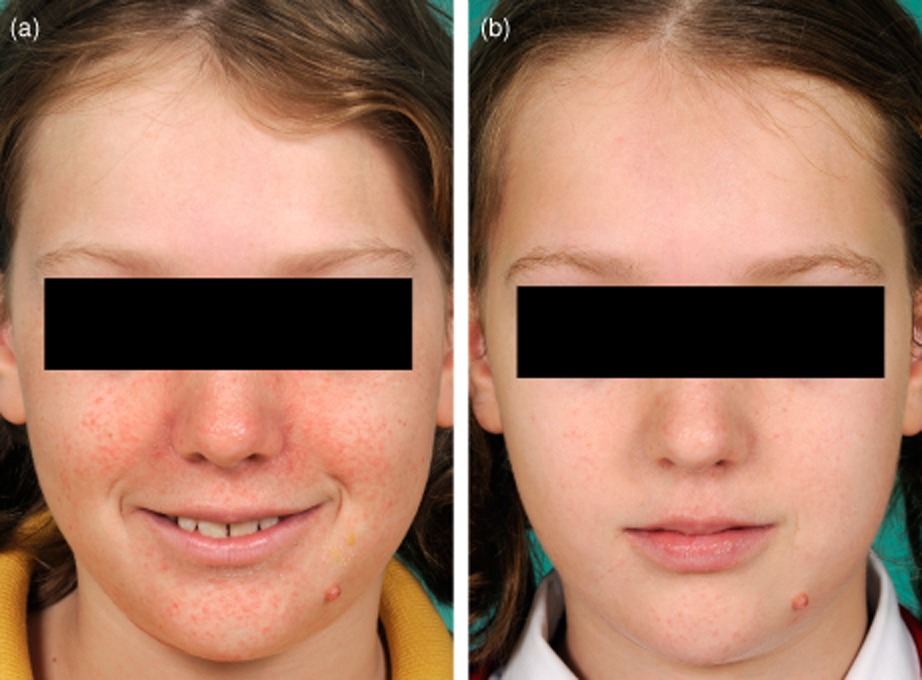
Topical rapamycin is a safe and effective treatment for facial angiofibroma associated with tuberous sclerosis complex (TSC), according to study results published in the British Journal of Dermatology.
Researchers performed a multicenter, double-blind, randomized, placebo-controlled, dose-response phase 2/3 study with a parallel design to compare the clinical efficacy and safety of 0.5% and 1% topical rapamycin cream vs placebo during 26 weeks of once-daily application in patients with TSC-related mild to moderate facial angiofibroma between October 2019 and May 2022. Patients were randomly assigned to receive rapamycin 1%, rapamycin 0.5%, and placebo cream. Safety and efficacy outcomes were assessed on days 14, 56, 98, 140, and 182, with a final follow-up visit on day 210. Severity of facial angiofibroma was graded using the Investigator’s Global Assessment (IGA) scale, which uses a 0 (clear)to 4 (severe) frange. Lesion severity was graded using the Facial Angiofibroma Severity Index (FASI), following the observation of facial erythema and the measurement of the size and extent of lesions. Mild, moderate, and severe facial angiofibroma corresponded to FASI scores of 5 or lower, 6/7, and 8 or higher, respectively, with a maximum possible score of 9. Safety and tolerability were assessed according to the frequency of adverse events (AEs), serious adverse events (SAEs), and treatment-emergent AEs (TEAEs).
The primary endpoint was the percentage of patients achieving treatment success, which the researchers defined (following an exploratory analysis) as a 1-grade improvement in IGA score. Secondary endpoints were days to treatment success, change from baseline IGA and FASI scores, change in subjective improvement ratings, and categorical improvement of FA at 26 weeks.
A total of 107 patients aged between 6 and 65 years were included in the study: 33 (mean [SD] age, 25.5 [15.0] years) in the rapamycin 1% group, 36 (mean [SD] age, 27.8 [15.0] years) in the rapamycin 0.5% group, and 38 (mean [SD] age, 26.3 [13.8] years) in the placebo group. Patient demographics and baseline characteristics were similar across the 3 treatment groups.
During the 26-week treatment period, 60.6% of patients in the rapamycin 0.5% group, 55.6% in the rapamycin 1% group, and 23.7% in the placebo group experienced at least a 1-grade improvement from baseline in their IGA score. Patients in the 1% or 0.5% groups had significantly greater likelihoods (5.1 and 4.7 times, respectively) of achieving a 1-grade IGA improvement compared with the placebo group.
After 26 weeks, IGA scores improved significantly in response to rapamycin 1% vs placebo (P <.001). There was also a significant improvement in response to rapamycin 0.5% at 2 weeks (P =.014), 8 weeks (P <.001), 14 weeks (P =.047), 20 weeks (P =.046), and 26 weeks (P =.002) compared with baseline scores. Mean time to treatment success was 17.44 weeks for patients in the rapamycin 0.5% group, 19.26 weeks for those in the rapamycin 1% group, and 24.8 weeks for those in the placebo group (both P <.001).
Treatments with 0.5% and 1% rapamycin improved FASI scores compared with placebo. When patients were asked to estimate the percentage improvement in the appearance of their facial angiofibroma on a scale of 0 to 100%, placebo treatment received a score of 30.8%, rapamycin 1% received a score of 54.1%, and rapamycin 0.5% received a score of 57.1% (both P <.001). Objective improvement scores, determined by the researchers, were also increased with rapamycin 0.5% and 1% vs placebo (both P <.001).
No patients had rapamycin detectable in blood sampling at 26 weeks of treatment.
Upon completion of the double-blind rapamycin treatment phase, patients reported moderate or significant facial angiofibroma improvements from baseline (rapamycin 0.5%, 90.6%; rapamycin 1%, 71.4%; and placebo, 36.1%).
Most reported TEAEs were mild (70.4%) or moderate (26.4%) and considered unrelated to the study drug application. No SAEs were reported.
Study limitations include its low recruitment rate, and use of the IGA scale and treatment success criteria as the primary endpoints.
The researchers concluded, “This study further confirms the utility of topical rapamycin for treatment of FA and demonstrates that the stabilised novel cream formulation used in the study represents a promising, clinically meaningful treatment for patients affected by FA associated with TSC.” They added, “A stable topical rapamycin cream formulation has the potential to be safely used in conjunction with other TSC treatments, including oral rapamycin.”
References:
Aitken P, Stanescu I, Boddington L, et al. A novel rapamycin cream formulation improves facial angiofibromas associated with tuberous sclerosis complex: a double-blinded, randomised, placebo-controlled trial. Br J Dermatol. Published online July 18, 2023. doi:10.1093/bjd/ljad243


