
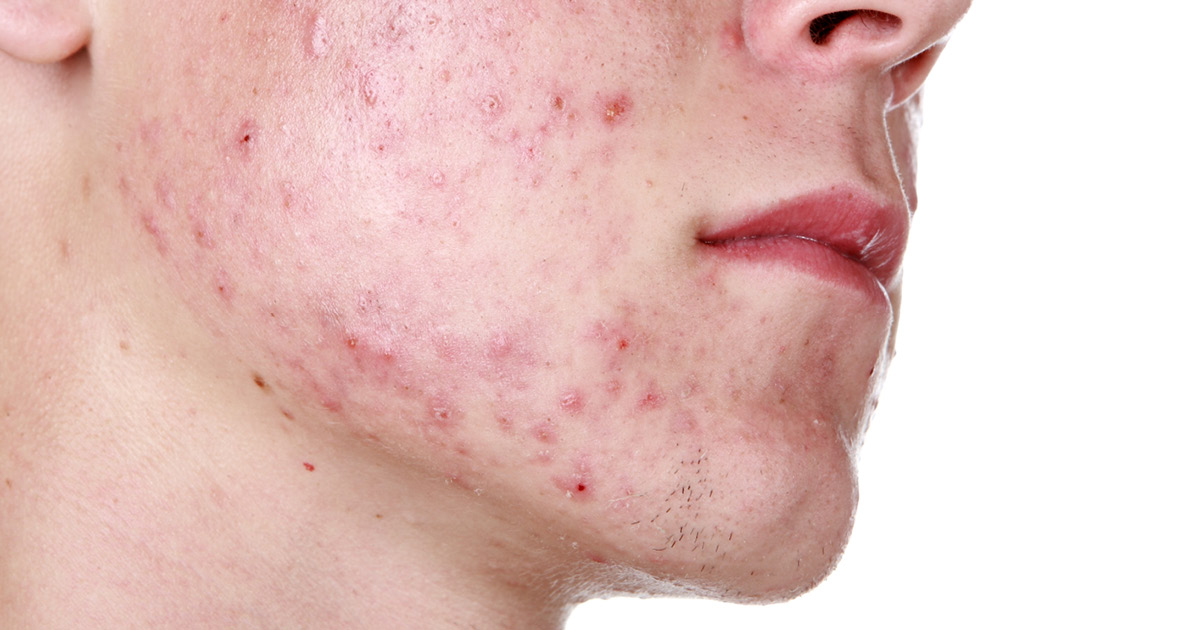
Treatment with microencapsulated benzoyl peroxide and tretinoin (E-BPO/T) yielded significant clinical improvement among individuals with moderate to severe acne, according to study results published in the Journal of the American Academy of Dermatology.
Researchers reported findings from 2 phase 3 trials designed to assess the efficacy and safety of an antibiotic-free, fixed-dose combination of microencapsulated tretinoin 0.1% and microencapsulated BPO 3% cream for acne vulgaris in patients aged 9 years and older. These parallel, randomized, double-blind, vehicle-controlled trials were conducted over a 12-week period at 63 US centers between December 2018 and October 2019.
Participants with moderate to severe inflammatory facial acne were randomly assigned 2:1 to receive either E-BPO/T or vehicle; both the active and vehicle treatments were cream formulations, self-applied to the face before bedtime daily for 12 weeks.
The coprimary efficacy endpoints were Investigator Global Assessment (IGA) success rate at week 12, defined as the percentage of patients who were “clear” (IGA score, 0) or “almost clear” (IGA score, 1) with grade 2 or higher improvement from baseline, and absolute changes in counts of inflammatory and noninflammatory facial lesions between baseline and week 12.
In the first phase 3 trial, a total of 281 participants were assigned to E-BPO/T and 143 to vehicle, of whom 249 (88.6%) and 131 (91.6%) completed the study, respectively. In the second phase 3 trial, a total of 290 participants were assigned to E-BPO/T and 144 to vehicle. There were 242 (83.4%) and 132 (91.7%) participants in the E-BPO/T and vehicle groups, respectively, who completed the trial.
Results of both trials showed that E-BPO/T was significantly superior to vehicle in terms of the percentage of participants who had IGA success at week 12. Among the intention-to-treat (ITT) population of the first trial, 38.5% of participants who received E-BPO/T had IGA success, compared with 11.5% of those who received vehicle (P <.001). In a multiple imputation analysis, 39.9% of participants in the first trial who received E-BPO/T had IGA success vs 14.3% of those who received vehicle (95% CI, 17.1-34.2).
Among the ITT population of the second trial, 25.4% of participants assigned to E-BPO/T and 14.7% of those assigned to vehicle achieved IGA success (P =.017). In the multiple imputation analysis, 26.8% and 15.1% of participants, respectively, had IGA success (95% CI, 3.6-19.7).
For participants in the first trial, inflammatory lesion count between baseline and week 12 was reduced by 21.6 among those in the E-BPO/T vs 14.8 among those in the vehicle group (P <.001). For participants in the second trial, inflammatory lesion counts were reduced by 16.2 and 14.1, respectively (P =.018). Noninflammatory lesion counts were reduced by 29.7 for E-BPO/T recipients and by 19.8 for vehicle recipients during this time period (P <.001), with reductions also observed among participants in the second trial (-24.2 and -17.4, respectively; P <.001).
In the 2 E-BPO/T groups, 24.7% of participants had an adverse event (AE) vs 11.9% of those in the 2 vehicle groups. Reported AEs included itching, burning, erythema, pigmentation, scaling, dryness, and stinging. The occurrence of AEs resulted in treatment discontinuation for 1.4% of participants in the first trial and 4.1% of those in second trial assigned to E-BPO/T, with no discontinuations reported among vehicle recipients. Overall, more than 90% of participants in both the E-BPO/T and vehicle groups had either mild or no signs and/or symptoms following the completion of treatment.
Study limitations include the 12-week follow-up period and the lack of comparisons between encapsulated BPO or tretinoin against their unencapsulated versions.
“These results will allow clinicians to administer 2 efficacious compounds as a single, once-daily product with a favorable tolerability profile,” the researchers concluded.
References:
Del Rosso J, Sugarman J, Green L, et al. Efficacy and safety of microencapsulated benzoyl peroxide and microencapsulated tretinoin for the treatment of acne vulgaris: results from two phase 3 double-blind, randomized, vehicle-controlled studies. J Am Acad Dermatol. Published online June 23, 2023. doi:10.1016/j.jaad.2023.05.093


