
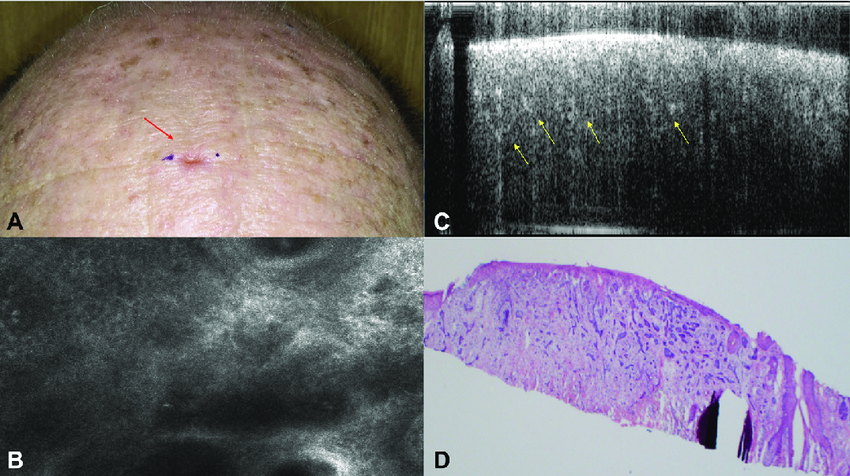
Adding optical coherence tomography (OCT) to clinical and dermoscopic examination (CDE) increases the ability to detect subclinical recurrent or residual basal cell carcinomas (BCCs) after topical treatment, according to study results published in the Journal of the American Academy of Dermatology.
As recurrent or residual BCCs may not be visible following topical treatment, researchers sought to determine whether CDE-OCT could increase detection rates without causing an increase in false-positive diagnoses. The study included adults with a superficial subtype of BCC (sBCC) who had undergone treatment in the Department of Dermatology, Maastricht University Medical Center, Maastricht, Netherlands. A total of 100 eligible patients were included in the study between January 2021 and March 2022. Patients were at least 18 years of age (mean, 66 years ± 14 years; 52% women) and had received topical treatment with imiquimod 5% cream (76%), 5-fluorouracil (11%), or photodynamic therapy (13%), within the past 5 years. Patients suspected to have a recurrence or residue based on CDE and/or CDE-OCT underwent a punch biopsy. Those with low suspicion of BCC on CDE and CDE-OCT were asked to voluntarily undergo a control biopsy, the results of which were used to verify the CDE and CDE-OCT diagnoses as the gold standard.
Only 12 recurrent or residual diagnoses of BCC were detected using CDE, while a total of 20 were detected using CDE-OCT. In addition, CDE resulted in 3 false positive tests, while CDE-OCT resulted in 1 extra false positive test, totaling to 4 false-positives Among the 76 patients who had negative results on both CDE and CDE-OCT, 9 consented to a biopsy for histopathologic verification; because none of the 9 had recurrent or residual BCC based on histopathology, the authors assumed all 76 patients with a negative test result were free from BCC.
The sensitivity for detecting recurrent or residual BCC was 100% for CDE-OCT vs 60% for CDE (P =.005). The specificity for CDE-OCT vs CDE was 95% and 96.3%, respectively (P =.317). The area under the curve for CDE-OCT was 0.98, compared with 0.77 (P =.001) for CDE.
This study included 2 main limitations: first, the results were based on only 2 OCT assessors; second, histopathologic verification of negative CDE and CDE-OCT test results were only possible in a small sample group (9 patients).
“In conclusion, compared to CDE alone, CDE-OCT resulted in a significant increase in sensitivity for diagnosing recurrent or residual BCC after topical treatment of sBCC without compromising specificity,” the researchers noted. They added, “Early detection of recurrent or residual BCC may prevent tumor progression, and may prevent additional follow-up appointments if no recurrence or residue is seen.”
References:
Wolswijk T, Adan F, Nelemans PJ, Defauwes A, Mosterd K. Optical coherence tomography for diagnosing recurrent or residual basal cell carcinoma after topical treatment: a diagnostic cohort study. J Am Acad Dermatol. Published online June 28, 2023. doi:10.1016/j.jaad.2023.06.033


